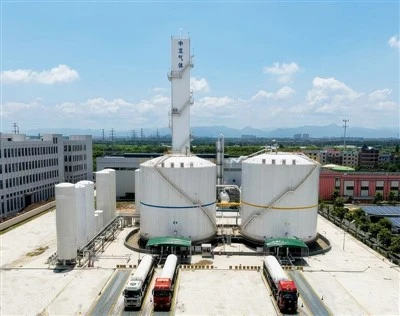
The cryogenic storage tank consists of a carbon steel outer shell, a stainless steel inner liner, and process piping. The space between the inner and outer shells is filled with perlite insulation. The inner and outer shells are designed, manufactured, and welded strictly in accordance with relevant national standards. After dozens of manufacturing and installation processes and successful inspection, the interspace is filled with perlite insulation and then vacuum-sealed during rolling.
Storage Tank Structure
The cryogenic storage tank has seven pipe connections. The upper connections are located at the top of the inner liner and include four pipes: a gas phase pipe, an upper liquid inlet pipe, a tank upper pressure tap pipe, and an overflow pipe. The lower connections are located at the bottom of the inner liner and include three pipes: a lower liquid inlet pipe, a liquid outlet pipe, and a tank liquid pressure pipe. All seven pipes are independently routed from the bottom of the storage tank.
The storage tank has one vacuum extraction pipe and one vacuum measurement pipe (both located at the bottom of the tank); a rupture disc is installed at the top of the tank (these three interfaces must not be tampered with).
The inner liner is fixed to the inside of the outer shell, using a cross-shaped angle iron at the top and a channel steel bracket at the bottom. The distance between the inner and outer shells is 300 millimeters. The storage tank is fixed to the ground with anchor bolts.
The outer wall of the storage tank is equipped with a fire sprinkler pipe, a lightning rod, and an anti-static grounding wire.
The storage tank is equipped with a pressure gauge and a differential pressure level gauge, each with a secondary instrument serving as a data acquisition and transmission terminal for automatic control.