Purified HBr: The Specialty Gas Powering Semiconductors, Solar, and Pharma - and Why Purity Is a Strategic Buying Decision
Meta description: Hydrogen bromide (HBr) has evolved from a niche industrial chemical into a critical specialty gas for semiconductor etching, solar cell texturing, battery manufacturing, and pharmaceutical synthesis. This article explains who buys ultra-pure HBr, why 5N and 6N purity command premium prices, and what to look for in a qualified HBr purification plant supplier.
Introduction: The Quiet Workhorse of Modern Manufacturing
Walk through a semiconductor fabrication plant at 2 a.m. and the only lights glowing besides the equipment are the faint, controlled flames of specialty gases doing their critical work. Among them, hydrogen bromide (HBr) - once considered a niche industrial chemical - has transformed into a backbone of the global high-tech economy. From the smartphone in your pocket to next-generation solar panels, electric vehicle batteries, and life-saving pharmaceuticals, purified HBr sits quietly at the center of some of the world's most demanding supply chains.
For procurement managers and operations directors, the question is no longer "why purify HBr?" but "who is willing to pay a premium for truly pure HBr - and why does purity determine production success?" This article pulls back the curtain on the real, data-backed market demand driving purified HBr, and explains why partnering with a specialized HBr purification plant supplier is a strategic decision, not just a cost consideration.
Why Ultra-Pure HBr Is the Backbone of Advanced Semiconductor Etching
The semiconductor industry consumes more purified HBr than any other sector by a wide margin. Modern microchips are built from billions of tiny transistors, and the precise patterns that make them work are created through dry etching processes, where gases react with silicon or metal layers to carve nanoscale pathways without damaging delicate structures.
For decades, dry etching relied on chlorine-based gases, but those leave behind residue that can shorten chip lifespan or reduce performance. Pure HBr changed that. It etches silicon and silicon dioxide (SiO₂) with unmatched selectivity, attacking only the material it is supposed to, while preserving the protective layers that keep the chip functional.
Purity is non-negotiable here. Even a trace impurity - as little as 1 part per million (ppm) of water or chlorine - can cause defects that force a 12-inch wafer (which yields roughly 1,000 high-end chips) to be scrapped, costing a fab USD 100,000 or more. That is why the world's leading chipmakers, from TSMC to Intel to Samsung, pay 20–30% more for HBr at 99.999% (5N) purity or higher, and are already shifting to 99.9999% (6N) grades for next-generation 3nm and 2nm nodes.
The demand trajectory remains strongly upward. The Semiconductor Industry Association (SIA) reports global chip sales reached USD 573 billion in 2023, and the dry etch gas market is projected to grow at 8.2% annually through 2030, with purified HBr accounting for nearly 15% of that segment. For semiconductor-grade applications, production-scale HBr purification plants tailored to 5N/6N specifications are exactly what fabs and electronic gas producers need.
HBr in Renewable Energy: Solar Texturing and Lithium-Ion Battery Production
The energy transition is opening a second major demand channel for purified HBr. In solar manufacturing, the most efficient panel designs today - PERC (Passivated Emitter and Rear Cell) and TOPCon (Tunnel Oxide Passivated Contact) - require thin, uniform anti-reflective and passivation layers. HBr is used to texture silicon wafer surfaces, boosting light absorption and reducing energy loss. As with semiconductors, even minor impurities cause uneven texturing that can lower panel efficiency by 0.5–1% - a significant gap when manufacturers are fighting to hit Tier 1 efficiency ratings.
Over the past five years, as the world races to scale renewable energy toward net-zero goals, demand for purified HBr in solar production has jumped by approximately 45% annually. Lithium-ion battery manufacturing adds to the pressure: HBr is used to etch and clean metal surfaces, including cathode materials and copper current collectors, removing oxidation and contaminants that would reduce battery life. With the International Energy Agency (IEA) projecting 14 million EVs sold in 2023 - up 35% from 2022 - every new battery plant needs a steady supply of high-purity HBr. Existing plants are also retrofitting purification systems to meet stricter environmental regulations, since impure HBr can release toxic byproducts requiring costly emission controls. The result is a dual demand: more volume and higher purity.
The Quiet Growth Engine: Pharmaceutical and Medical Manufacturing
A less visible but fast-growing segment is medical and pharmaceutical manufacturing. HBr is a critical raw material for producing antibiotics, anti-virals, and cancer treatments. Bromine-based compounds derived from purified HBr are used to synthesize active pharmaceutical ingredients (APIs) in drugs such as atropine (for heart rhythm disorders) and several HIV medications.
Regulators set extremely strict standards for API feed gases: HBr used in drug production cannot contain more than 0.1 ppm of heavy metals or organic impurities, because even trace contaminants can cause adverse reactions in patients. As a result, pharma companies are increasingly partnering with specialized gas suppliers rather than buying low-purity HBr from general chemical manufacturers. The global market for pharma-grade specialty gases reached USD 12.8 billion in 2022, with HBr among the fastest-growing segments. Beyond APIs, HBr supports medical device production - from MRI contrast agents to antimicrobial coatings on surgical tools. This segment demands rigorous documentation and regulatory audits, but once a supplier is qualified, contracts tend to be long-term and highly reliable.
Semiconductor Packaging and Advanced Displays: The Next Demand Frontier
A lesser-known demand driver is semiconductor packaging and advanced display manufacturing. When chips are packaged for consumer electronics, they often use through-silicon vias (TSVs) - tiny holes drilled through the silicon wafer to connect chip layers. HBr is the preferred gas for etching TSVs because it creates smooth, uniform holes that do not damage internal circuits. For high-end displays such as OLED and MicroLED, HBr patterns the thin-film transistors that make up display pixels.
The global OLED display market is projected to reach USD 100 billion by 2025, and as display makers shift to larger, higher-resolution panels, they demand higher-purity HBr to avoid pixel defects. Semiconductor packaging is growing even faster than chip manufacturing itself, with TSMC's 3D fabric plans expected to drive 12% annual growth in HBr demand for packaging through 2030.
What It Takes to Deliver 5N and 6N HBr
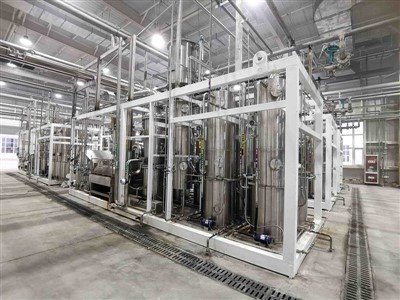
Meeting this demand is technically demanding, and that is where specialized purification capability makes the difference. Many general chemical manufacturers produce HBr by reacting bromine with hydrogen gas, a process that leaves behind impurities such as water, residual bromine, and carbon-based compounds. Reaching 5N purity requires specialized purification trains: cryogenic distillation, adsorption, and membrane separation, all controlled in a closed, contamination-free environment.
Production also carries operational challenges. Bromine is highly corrosive and toxic, so facilities need specialized safety infrastructure to comply with OSHA and EPA regulations. Purification is energy-intensive, which makes process automation and energy-efficient distillation essential to keeping costs competitive while holding strict purity standards. For manufacturers that need multiple high-purity gases, an integrated supplier offering complementary electronic gas purification, fluorine chemical, and rare gas equipment creates a one-stop advantage across the specialty gas portfolio.
Supply Chain Resilience and Localization
Another trend shaping the market is supply chain resilience. After the 2020 chip shortage - exacerbated by bottlenecks in specialty gas production - nearly every major high-tech manufacturer is localizing supply chains for critical inputs like purified HBr. Production is moving away from a small number of global hubs toward North America, Europe, and other regions with advanced tech sectors. For HBr purification plant suppliers, this means being able to scale production quickly as clients grow, without compromising purity, while offering dependable delivery and transparent logistics.
Who Is Really Buying Purified HBr?
The customer base is far from uniform:
Multinational semiconductor fabs that need thousands of metric tons of 6N HBr annually under five-year contracts.
Solar panel manufacturers that need consistent purity at growing volumes as they scale production in new regions.
Pharma API producers that need small, frequent shipments of ultra-pure HBr with complete documentation to pass FDA audits.
Advanced display and 3D packaging manufacturers that are pushing the boundaries of HBr purity for next-generation products.
For each of these buyers, even a small defect in the HBr supply can derail production, delay product launches, or lead to costly scrap.
A Supply Partner Built for High-Purity Specialty Gas: Introducing the HANTURBO HBr Plant
If your operation depends on purified HBr - whether for semiconductor etching, solar texturing, battery processing, or pharma-grade synthesis - the reliability of your gas supply is a strategic decision. That is precisely where HANTURBO (hanturbo-gas.com) positions its specialty gas equipment portfolio for overseas buyers.
Established in 2012, HANTURBO is a comprehensive solution provider integrating the design, manufacturing, installation, commissioning, and maintenance of air separation plants and specialty gas purification equipment. Headquartered in Zhejiang, China, with its manufacturing base in Huzhou - approximately 200 km from both Shanghai Port and Ningbo-Zhoushan Port - the company offers practical logistics advantages for overseas equipment orders. Its product portfolio covers specialty gas production and purification systems for N₂O, BCl₃, 3MS, C₃H₆, C₄F₈, C₂F₆, CO₂, CO, and HBr, serving the semiconductor, electronics manufacturing, and photovoltaic industries.
What sets HANTURBO apart is its deep technical foundation: the company runs a strategic industry-university collaboration with Zhejiang University, one of China's top three universities, and in June 2025 established the Zhejiang University Specialty Gas & Equipment Innovation Team to develop 6N-grade electronic gases - addressing the very purity frontier that VLSI/ULSI semiconductor manufacturing depends on. HANTURBO's HBr Purification Plant is built for exactly the use cases described in this article: scalable production, consistent 5N/6N purity, regulatory compliance, and flexible engagement models that serve everyone from startups launching advanced display technologies to global chip giants expanding fabs. The company operates under ISO9001, ISO14001, and ISO45001 quality and management systems, holds a Production License for Special Equipment and AAA enterprise credit ratings, and ships to clients worldwide, from large multinationals to small specialist firms.
Whether you need a steady long-term supply of 99.999% HBr or small batches of ultra-high-purity gas for R&D, HANTURBO can tailor a solution - and its complementary electronic gas purification and specialty gas systems support operations end to end.
Conclusion: Purity Is the New Competitive Advantage
Purified HBr sits at the intersection of technology, energy, and healthcare - three industries that will only rely more heavily on high-purity specialty gases in the years ahead. As etching nodes shrink, solar cells push efficiency limits, battery plants scale, and regulators tighten purity standards, the gap between commodity-grade and semiconductor/pharma-grade HBr will keep widening. Choosing the right supply partner is no longer a line-item cost; it is a strategic decision that protects yield, compliance, and product launch schedules. For procurement teams exploring purified HBr requirements or specialty gas equipment, speaking with a specialized supplier like HANTURBO is the first step toward a resilient, high-purity supply chain.
FAQ: Common Questions About Purified HBr
Q: What purity grade of HBr do semiconductor fabs require? A: Leading fabs typically require 99.999% (5N) purity today, with 99.9999% (6N) grades becoming the standard for 3nm and 2nm advanced nodes.
Q: Why does HBr purity matter for solar cell production? A: Impurities cause uneven silicon texturing, lowering panel efficiency by 0.5–1%, which can determine whether a manufacturer meets Tier 1 efficiency ratings.
Q: How is high-purity HBr produced? A: High-purity HBr is produced through cryogenic distillation, adsorption, and membrane separation in closed, contamination-free environments - capabilities at the core of specialized HBr purification plants.
Q: Which industries buy purified HBr? A: The main buyers are semiconductor fabs, solar and lithium-ion battery manufacturers, pharma API producers, and advanced display and 3D packaging companies.